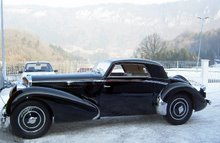
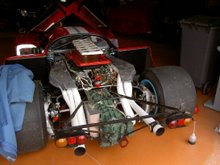
I thought that the sight of a Lamborghini V12 installed in a Miura might be of interest to some of my readers.
I did a fair bit of work on this car last year - some of you may have seen the pictures of the carburettors on this blog at the beginning. As I remarked above, installing the engine is incredibly awkward - a shoe-horn is a great help!
A full size picture can be found here
Monday, January 15, 2007


Friday, January 12, 2007
A Trip Away
I have just returned from a trip to the beautiful Jura area, about 100 miles/160km away from home. I went to attend to a delightful S1 Fulvia Sport (Zagato) for a new customer.

I shall be writing this up - AND potential clients can be assured that they will receive the same excellent service...

I shall be writing this up - AND potential clients can be assured that they will receive the same excellent service...
Fulvia Engined Special - Part II
I ended the first episode of this story with the introduction of the topic of the dry sump and in particular, the modifying of an original sump to suit the new system. Now read on.

The next step was to contact an English firm well known to us, Pace Products of Cambridge who, Robert said, were extremely helpful in determining the specification for the system. After selection of components suitable for the Fulvia 1300 engine, eventually all was completed. Here are some more pictures. The first shows the pump mounted on the engine; as may be seen it is driven by a toothed belt from the crankshaft. The second shows the pump in place on the engine (in the car) whilst the last shows a more general view including the hydraulic clutch (see below). Sharp-eyed readers will note that Robert has opted for an Integrale oil filter; if this doesn’t register with you then read “Fulvia Thoughts II” on this blog!


WHY DRY SUMP?
I encouraged the dry-sump approach partly because I remembered that another Fulvia specialist, Peter Gerrish, told me that he had obtained an additional 5 bhp on a modified 1600 engine just from the addition of a dry-sump system. It seems that the Fulvia engine does suffer quite considerable pumping losses and of course the standard crankcase breathing arrangement is really rather crude and certainly inadequate – hence the additional breathers fitted to the works rally cars. By reducing crankcase pressures and the quantity of oil adhering to the crankshaft, power is saved and the oil is no longer exposed to combustion by-products and general “thrashing”. Furthermore there is no risk of oil starvation at high cornering speeds, an important point in a mid-engined car with a low centre of gravity, plenty of grip - and a determined driver in charge. I would expect the overworked centre main bearing to last longer with a dry sump system!
In general, as far as I know, the engine is not greatly modified. The head has had a little work I recall, but I would think that the dry sump and the excellent exhaust system together could be worth perhaps 10 bhp and most likely with improved torque. Considering the low weight of the complete car I would expect it to go very nicely indeed – in fact Robert says that it “feels quick”.
CLUTCH
As most of you will know, the Fulvia’s clutch is operated by means of a cable. Whilst this works, I have never liked it much, especially since I once had one snap late one night, at the weekend naturally. Certainly on right-hand drive cars there are two fairly tight curves, which with the passage of time often cause rather a sticky or at least heavy, action. On my own car I have replaced the cable with a solid rod, which is a revelation – and of course unbreakable.
It was obvious after a moment’s thought that a cable would be a very poor solution for Robert’s car; the necessary curves would have made the operation very poor. I suggested that the only possible solution was an hydraulic system. Whilst there is limited room for this approach on the Fulvia’s bellhousing, Robert with his usual ingenuity managed it. The slave cylinder, mounted on top of the bell housing actuates a modified original clutch arm. The third of the pictures above shows the arrangement.
To be concluded.
Saturday, January 06, 2007
Another Monster
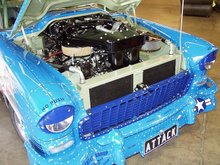
Have a look at the mad Chev at the top right of the page. And then see the pictures below. Completely mad, but lovely work. The pictures were loaded to the Atlas Technical Forum here by "NTSOS".


Fulvia Engined Special - Part 1
 Once again/Une fois encore, Happy New Year/Bonne Année to all/à tous.
As promised, I have now written up the piece on the mid-engined special featured on the top right of the page. It is rather long and with many pictures, will be published in three parts.

Part 1
About three years ago, when I was manager at Evolution Engineering in London, I had a visit from an occasional customer, whom I shall call Robert. In fact the first visit I recall related to Robert’s need for an exhaust for his S2 1300 coupe. Soon after this he returned with various engine bits on which he sought my opinion. It was then that he explained that he was intending to build a mid-engined car that would use a Fulvia engine and five-speed gearbox. As an inveterate modifier myself, I was delighted to assist at least with advice, and from a business point of view, supplying parts etc.
With the car now legal and running well (although there are a few details to finish and one or two minor faults) Robert’s achievement is superb. He has had to solve numerous technical problems, all without any predecessor to follow, a true expedition into the unknown.
This is not intended to be an exhaustive description of every aspect of the car’s construction; after all I was not present, but my intention is to provide some information about the car in general but mainly to describe some of Robert’s excellent problem-solving and at the same time discuss points that might be of interest to Fulvia enthusiasts. Additionally, I know that Robert is writing up the story for Viva Lancia! the magazine of the English Lancia Motor Club. And I make no excuses for the many photographs I have included; the project deserves them. I should add that all the pictures are Robert’s.
Robert writes:
“What got me started on the project? I'd always fancied building my own race
car, and after building and driving my Westfield for a couple of years I
thought I'd give it a go. Requirements were: space-frame chassis, small
engine, double wishbone suspension all round, low weight, low centre of
gravity, low polar moment of inertia and low cost!”
“Originally I was going to build my own mid-engined chassis and copy the suspension geometry from a kit car manufacturer and then make my own body. My engine choice was limited to a longitudinally mounted engine, and as modern car manufacturers can't be bothered to build interesting drive train packages (except Subaru), it would have to be an older engine, an Alfa 33 engine - beautiful engine, low centre of gravity, excellent power and inboard discs.”
“I went off the idea of building my own chassis and body when I came across MK Engineering’s GT1 project (now sold to Spire Sportscars), realising I wouldn't do better and it would save years! After enjoying my Fulvia so much and succumbing to the Lancia bug, I decided to forgo a little power and 'weight ideals' and went for a Fulvia unit instead of the Alfa. I went straight off to MK Engineering in Doncaster with a dummy engine and gearbox, and found they would easily fit in the 'motorbike engine bay', and the gearbox just fitted the rear of the chassis, where a large chain-driven sprocket was supposed to be. My plan for building the car was simple - mount the gearbox centrally and then build all the parts around the engine/gearbox!”
“Two years later I'm just about done!”
Makes it sound easy doesn’t he? But anyone who has carried out any significant modifications can probably imagine how difficult building a complete car from an “idea” can be.
For example, have a look at an early picture; from this point it is clear that Robert had a daunting task ahead of him.

At the beginning, we discussed many aspects – it’s a pity I didn’t make notes – but I do recall pointing out that one particular difficulty would be arranging the clutch release and another, even trickier, the gearbox change mechanism, with the engine/gearbox assembly being behind the driver. More of these later.
As may be seen from the pictures, the chassis is quite simple in construction, being a space-frame constructed from square-section steel tube, and stiffened in the classic way with riveted panels. Certain features are attractive: note for example, the long wishbones front and rear, and the adjustable geometry and of course rack and pinion steering; there is no engine in the way to hinder the installation of the latter! Given the weight of the Fulvia gearbox (about 65kg), such adjustments could well be useful I think. The running gear is supplied by the makers; note the aluminium uprights. I understand that the rest, hubs and so on, in best “special” tradition, are Ford components.

DRY SUMP
Apart from general planning, much of Robert’s early work concerned the engine, always my favourite part of any car and after our having discussed the advantages of dry sumping, he decided to opt for it. He began by modifying a Fulvia sump by cutting and welding:


To be continued...
Friday, January 05, 2007
SNAP Preview
OK I'll hold my hand up; I still haven't finished the first part of the promised articles - about the mid-engined special or indeed the "mystery" engine. There will be a further delay because I have to go away for a few days to work on a S1 Zagato that requires quite a bit of attention.
Meanwhile in an attempt to make this site easier to use I have added a feature called Snap Preview. Each time you pass your cursor over one of the links I have included, you will get a preview of the linked site. Quite useful I think. For example: this.
I have added a link to SNAP on my links list on the right of the page for those who would like to try it.
Meanwhile in an attempt to make this site easier to use I have added a feature called Snap Preview. Each time you pass your cursor over one of the links I have included, you will get a preview of the linked site. Quite useful I think. For example: this.
I have added a link to SNAP on my links list on the right of the page for those who would like to try it.
Sunday, December 31, 2006
Happy New Year/Bonne Année
A Happy New Year to all my English-speaking readers and...
pour mes lecteurs et lectrices français(es) Bonne Année.
You will have noticed the dearth of new Fulvia material over the last few days, but bear in mind please, that this is the season of conspicuous consumption! (pour les Français, naturellement, 'consommation avec moderation'!)
As a little "taster" I have attached another snap from the forthcoming article about the mid-engined Fulvia-engined special.
pour mes lecteurs et lectrices français(es) Bonne Année.
You will have noticed the dearth of new Fulvia material over the last few days, but bear in mind please, that this is the season of conspicuous consumption! (pour les Français, naturellement, 'consommation avec moderation'!)
As a little "taster" I have attached another snap from the forthcoming article about the mid-engined Fulvia-engined special.

Thursday, December 28, 2006
Sunday, December 24, 2006
A Holiday Show for Cat Lovers Everywhere

Thursday, December 21, 2006
Christmas Card
 Merry Christmas to all my readers.
The illustration (courtesy Jusdesign) whilst certainly of interest to Fulvisti actually has a bearing on a forthcoming piece that will appear on this blog, concerning the "mystery" engine featured a last week.
Look carefully at the "overlap" between cylinders 1 and 2; therein lies a clue to a key part of the future article.
Special thanks to CM for all the "Photoshopping".
Look carefully at the "overlap" between cylinders 1 and 2; therein lies a clue to a key part of the future article.
Special thanks to CM for all the "Photoshopping".
Best wishes to all.
Thursday, December 14, 2006
New Picture
The new picture on the right of the page shows a mid-engined Fulvia special.
As the caption reads, this is another subject I shall be writing up soon.
Here's a link to a bigger version of the picture
As the caption reads, this is another subject I shall be writing up soon.
Here's a link to a bigger version of the picture
Mystery Picture - More soon
 Click on picture for full size image
Come on then Les Experts, who can identify the engine on the bench - under test...?
The only clue I can offer is that there has only been one exactly like this one.
I will in due course, be writing up the story of this and my part in it.
In the meantime, let's hear from some of you.
And don't forget, for those of you in France, Fulvia expertise is available at reasonable prices - right here in Haute Savoie, about 30km from Geneva. Contact VAR1016@gmail.com
The only clue I can offer is that there has only been one exactly like this one.
I will in due course, be writing up the story of this and my part in it.
In the meantime, let's hear from some of you.
And don't forget, for those of you in France, Fulvia expertise is available at reasonable prices - right here in Haute Savoie, about 30km from Geneva. Contact VAR1016@gmail.com
Wednesday, December 13, 2006
Talking Point
 The Fulvia Coupé rally cars are justly well known, but the "Sports" were also widely used in competition - perhaps most famously by the Factory at Daytona, using one of the first 1600 engines in 1968.
About 30 "Competizione" Sports were built by Zagato. These featured very extensive lightening as may be seen in today's picture.
The car shown is very, very special. It belongs to Carlo Stella who has written a book about the Competiziones. The car was developed around 1972 by one of the famous Italian tuners: Samuele Baggioli. The engine, a 1300 is fitted with Kugelfischer fuel-injection complete with specially made slide throttles. I took the photo at the Fulvia 40 celebrations in Turin in 2003. The engine is said to make 143HP at 8500 rpm. I heard it running and am not inclined to doubt... "Whang, whang, whang"!!
Sunday, December 10, 2006
Comments
Thanks to William for adding interesting comments - to "Fulvia Thoughts" 2, 3 and 7.
No need to be shy then - let's hear what you have to say!
No need to be shy then - let's hear what you have to say!
Saturday, December 09, 2006
I Said I like Cats - and of Course, I am not Alone
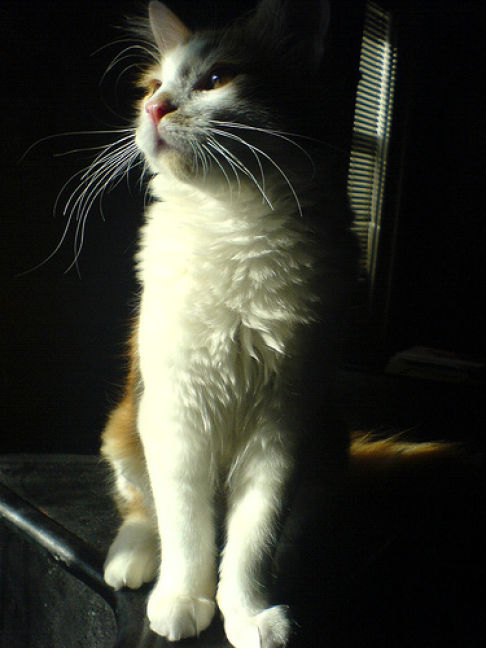
" Si vous êtes digne de son affection , un chat deviendra votre ami , mais jamais votre esclave." Théophile Gautier
Comments

comments Where comments comments comments comments comments comments?
comments comments Are comments comments comments comments comments?
comments comments comments Your comments comments comments comments?
comments comments comments comments comments Comments comments?
comments comments comments comments comments comments ? comments?
comments comments comments comments comments comments comments ?
comments comments comments comments comments comments comments ?
I need those comments now!
comments comments comments comments comments comments comments ?
comments comments comments comments comments comments comments ?
Thursday, December 07, 2006
Lancia Cursor
 Here's a life-size picture of the Lancia cursor that I can provide to anyone who wants one. It is animated and thus rotates.
Email me on VAR1016@gmail.com
Wednesday, December 06, 2006
Fulvia Thoughts - 7
The seventh in the series, this one returns to the engine with some thoughts about Fulvia camshafts
I wanted to include a scan of the Technical Data, but cannot upload it. I will happily email it to anyone who wants a copy. Contact me on VAR1016@gmail.com
I wanted to include a scan of the Technical Data, but cannot upload it. I will happily email it to anyone who wants a copy. Contact me on VAR1016@gmail.com
Considering the fact that the Fulvia was in production in a variety of forms for 13 years, it is perhaps quite surprising that only six types of camshaft were listed in the published technical data.
For me there were probably only four different “production” camshafts: this is suspicion rather than established fact, and I would be interested to hear from anyone who has had the opportunity to study the various types really thoroughly.
1) 818.000: I suppose that only very few of us have ever seen these which were fitted only to the very earliest cars
2) 818.100/130/202/282/302: A common one this, found in many models – e.g. 1200 and 1300 S1 coupes and sedans and also S2 sedans.
3) 818.140/342/303/540: Now then… You will see that the data give different timing for the early HF camshafts fitted to 1.2HF and early 1.3HF cars. But note: the duration (274 degrees) is the same as the later 342 cars and also 540s and 303s. The only difference in the data is the lift at TDC, given as 1.8mm for early models and 2.2mm for later ones (I have chosen to ignore the 0.05mm difference in the valve clearances as I feel that eight-tenths of a thou. is nothing to worry about). I suspect that all these have the same profile, and the timing difference may be explained by the different setting at TDC. I think that the 24/72/72/24 timing given in the owner’s handbook for S1 coupes (for the 1.3HF) may be safely ignored.
4) 818.540 (VAR 1016). No comment about these near-mythical components except that it is strange that whilst the duration has been increased by 14 degrees, lift at TDC is the same as that given for the 303/342/540 cams (take your pick). One could be forgiven for thinking that given the larger carburettors and (I presume) detail work to the porting, that greater lift would have been provided to take advantage of these modifications.
In my view apart from the profiles (obviously) there are only two important differences between early and later camshafts. First, the early camshafts, certainly the 818-100 ones, appear to have been made from steel and case-hardened. These have a thinner hardened layer and usually, have not proved to be suitable for re-grinding. In any case, the normal 818 100/302 has a small lobe and provides little scope. If you have a sympathetic camshaft man, the best camshafts for experiments are those found on S2 1600s or very early S2 coupes. These are made from cast iron and have thick hardened layers especially at the nose making them suitable for re-grinding. And (second difference) most importantly they have the vernier holes allowing them to be set up accurately. Incidentally, most S2 sedan engines are fitted with cast-iron camshafts with vernier holes – but of course they have the 302 (i.e. 818-100) profile. The true S2 and S3 (coupe) camshafts are of the “one pin one hole” type and are therefore useless for truly accurate setting – they are fine otherwise though, being of the same excellent material and of course identical in other respects and since they are plentiful, it may be wiser to experiment with these rather than the rarer and more valuable vernier type. Incidentally, it is possible to use the vernier cam wheels with the “one-pin” camshafts.
Those thinking of approaching a camshaft man with “ideas” should take a rocker along to show him. A moment’s thought will show that a profile originally conceived for a push rod engine will not be ideal as the followers in such an engine will be notionally flat whilst of course the Fulvia cam “sees” a curve which naturally affects the opening and closing characteristics.
I have come across two other types of camshaft, both of which were supposed to be works profiles. He first was the profile sold by Barry Waterhouse at Evolution Engineering where I worked and was manager for a couple of years. Barry showed me the originals which were highly polished “billet” shafts – i.e. machined from steel billet and hardened. These were pretty radical. Timing was something like 50/70/70/50, therefore offering 300 degrees’ duration with full lift at 100 degrees. And moreover, lift at TDC was 4.3mm and full lift at the valve, 11.3mm. They are very effective, but hard on the valve gear (owing to the acceleration).
The second profile I acquired having ordered a pair from Italy to original works part numbers from a 1967 parts book. When they arrived they were marked 43/77/77/43 with 3.8mm lift at TDC. Maximum lift is from memory, 10.3mm.
I expect that the works experimented with a variety of profiles for competition use. If anyone has any more information about this topic I would love to hear from them.
Tuesday, December 05, 2006
Cats & Michel de Montaigne - Erratum

Picture by xgianaxandxnick
I have been taken to task by CM, over the error in the French of the de Montaigne quotation that I posted yesterday.
CM directed me to a link that lists many famous French cat quotations including of course this one. My excuse is that I copied the quote directly from The Oxford Dictionary of Quotations. I thought at the the time that "...joue à mon chat" was a bit strange, thinking that "avec" would be better, but I have enormous trouble with French prepositions so did not feel in a position to challenge it!
CM directed me to a link that lists many famous French cat quotations including of course this one. My excuse is that I copied the quote directly from The Oxford Dictionary of Quotations. I thought at the the time that "...joue à mon chat" was a bit strange, thinking that "avec" would be better, but I have enormous trouble with French prepositions so did not feel in a position to challenge it!
So once again:
" Quand je joue avec mon chat , qui sait s'il ne s'amuse pas plus de moi que je le fais de lui ?"
(When I play with my cat, who knows whether he isn’t amusing himself with me more than I am with him?)
Lancia Pictures

Looks jolly serious doesn't it? (Click on picture for the full-sized version).
A 1962 Flaminia Supersport in competition guise, I found this picture on a site that boasts lots of LANCIA pictures and "wallpapers". A chance for you to tart-up your computer or blog!
Again I have added the link to my links section
Subscribe to:
Posts (Atom)