Adsense

A bit of music from the lamented Radio Blog Club

Le Français

Toujours, je suis désolé pour mes amis( et amies) français(es), mais il est difficile pour moi d'écire en français. Peut-être un jour...
S.V.P. regardez ce LIEN
Showing posts with label mid-engined. Show all posts

Friday, August 03, 2007

Fulvia Mid-Engined Special: an Update


For more recent readers, the original articles on this car were HERE and HERE.

Robert the owner, is not a man for standing still. He has decided that fuel-injection is the way forward. We did exchange a few emails on this topic, I pointing out the expense and complexity etc.

However, not to be deterred, Robert pressed on and sourced a set of Japanese motor-cycle injection. His immediate problem was how to mount this onto the Fulvia inlet manifold. This was solved by the very nice piece of machining shown here..


When assembled, as the pictures show, the installation looks extremely good. I am waiting to hear how this will all be programmed etc., but I suspect that the results will be excellent.


Even more radically, the latest idea is to invert the inlet manifold enabling downdraught inlet and providing plenty of cold air.

That 500kg 1300cc car will be even quicker than when I had a ride in it.

More in due course.

Saturday, February 24, 2007

A Rare Treat

The rightfully proud owner arrives for "refreshments"
Note the wet!

Those of you who have visited this blog recently will know that I am currently in "Blighty" attending to a much modified Land-Rover. Despite the title at the top of the page, I shall probably be writing something about this in due course - those who know me will be well aware that motor-car modifications have always been a source of fascination to me.

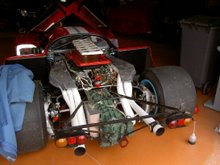
I am in Suffolk, and as my friend and sometime customer Robert Ely lives quite close, here was the opportunity to sample his amazing Fulvia-powered mid-engined sports car.

A couple of phone calls and today, Robert arrived as arranged at "The Plough" just after one o'clock. The weather had been pretty foul in these parts so poor Robert arrived rather cold and damp - a glance at the car will reveal the realities of Le Mans-style motoring in February in England. The car sounded a little sick when it arrived, but at that moment the priority was suitable refreshment and luncheon.

These important matters having been dealt with, we set off back to the house where in my Land-Rover client's warm and spacious garage, we could investigate. I was determined to put matters right since I wanted to experience the car, the ride home being "hiccupy" to say the least.

Engine cover up ready for examination

I expect that Robert will forgive me for telling you that he confessed to having "fiddled" with the carburettors somewhat, but I was convinced that the problem lay with the ignition system. Obviously, the clue lies in the rainwater that can be seen in some of the pictures. Sure enough, the distributor cap had plenty of moisture inside, as did the rotor arm. Surprisingly despite the cam cover being rather exposed, there was no water around the plugs - a common Fulvia problem.

The exposed cam cover may be seen in this picture;
this will be protected by a cowl at the front

I cleaned and dressed the rotor arm carefully and added a squirt of WD40 to the cap. On starting up it was obvious that things were a lot better, although not right. I therefore turned my attention to the carburettors. The special tools I have for this job are attached to my head: my ears.

Five or ten minutes with a screwdriver sufficed. I was impressed with the throttle response which I believe is largely due to the very nice exhaust manifold and the vastly better air filter.

"Road test" I said.

So off we went. Mercifully the rain held off, although I soon became quite wet owing to Robert's aerodynamic modifications... The engine sounded excellent and the car is fast - very lively indeed; with probably about 100hp and 500kg this is unsurprising! The gearchange is "back to front" but the low weight means that starting from rest is easy in 2nd gear. The chassis as far as I could judge, is excellent with a firm but comfortable ride, plenty of grip and good turn-in. Sharp-eyed readers will notice that Robert has now fitted attractive 15" aluminium-alloy wheels with very nice sticky Toyo tyres.

My Land-Rover client was keen for a ride so despite being a rugby fanatic, tore himself away from the "Six nations" on the TV.


Looking slightly wind-swept on his return, "Almost as good as my green Land-Rover" he commented!


The windswept return

This is a very serious motor-car; the especial pleasure for me was to hear that mildly modified Fulvia engine sounding like the thoroughbred it is - right next to my right ear.

Robert showed me some of the aerodynamic developments he has been working on, including special venting for the radiator at the front, and a diffuser at the rear.

There is more to come (including a paint job); I shall keep you all informed.

Wednesday, January 17, 2007

More on the Mid-Engined Special

You will recall that in the last piece on this car, I congratulated Robert on a job well done.

In the piece I also remarked that there was some finishing to do...

More than some! Robert has taken my advice and subscribed to Atlas

If you go to this thread in the technical forum, you will see that Robert (aka "Robroy") is very serious indeed. If he continues in this way I would expect Fiorio and Maglioli to come out of retirement and offer their support - after all it will probably end up quicker than an F&M special - 500kgs indeed!

Tuesday, January 16, 2007

Fulvia Engined Special - Part III

Here then is the final part of this feature; I hope that it has proved to be of interest. One man's ideal is always different from another's and nearly always fascinating and instructive. I hope that you agree.

GEARCHANGE

To me, solving this one was Robert’s greatest achievement. The linkage mechanism on a S2 Fulvia is really very simple. The gear lever is mounted at the bottom on an adjustable swivelling threaded shaft. A couple of inches above the mount, the lever carries a ball which locates in a nylon lined yoke. The yoke is in turn attached to a (unnecessarily heavy) steel shaft. At the end of the shaft, mounted laterally at 90 degrees is a steel cup which mates with a ball on the vertical actuating shaft on the gearbox proper; this ball is also laterally at 90 degrees to the vertical shaft. Thus, sideways movement of the lever causes the (control) shaft to rotate, lifting the actuating shaft, which selects one of the three positions or “gates” (1st and reverse, 2nd and 3rd, 4th and 5th) whilst pushing or pulling the lever selects the individual ratios. I hope you have followed this “very simple” description! Good… well now, this is all very well when the gearbox is directly in front of the driver. Pause for a moment to imagine how you are going to change gear with the gearbox behind you AND with a 1300cc V4 engine in the way!

Perhaps some of you are prototype engineers or toolmakers, with finely-equipped toolrooms at your disposal and are laughing at my description of the difficulty, but bear in mind this was largely a home operation. I suppose that a complex system of bell-cranks and levers all running in bronze bushes, with numerous rose joints could have been designed and constructed, but this would have been heavy and costly and could have ended up with almost as much slack as the steering on a V16 BRM. And perhaps Robert might have opted for a right-hand gear change that would have made routing a bit easier, but there was a better way.

After much head-scratching and consulting with MK Engineering (makers of the chassis), Robert selected the cable linkage from a Ford Focus. You will see in the pictures that he has cleverly adapted parts of the original Lancia system to their new purpose. Robert reported that this worked fine – in the fore and aft sense; all he now had to do was arrange for the up and down part; not so easy.

In fact the problem was solved by using the second cable of the Focus system acting from below on an additional piece welded to the “cup” that mates with the actuation shaft, controlled by a spring, which of course retains the gear lever in the normal position. Robert says that the gear change is smooth and positive in action.


The rest of the installation is more straightforward, but read a brief report I received from Robert:

I can't remember what stage I was at with my last update, but things are coming along fairly well at the moment. I've finished my hydraulic clutch and it works, but all the floor-mounted pedals are horrible and need modifying. Handbrake mechanism, seats, oil tank and hoses, suspension, steering, cooling system, brakes and wiring loom are nearly finished, although it’s proving tricky without a manual or any parts available off the shelf! I've also nearly finished a nice little bracket that acts as a mount between a section of the oil sump pan/crankcase and the chassis.


Voila! Building a car from scratch is a complex business.


Naturally, it was necessary to fabricate all kinds of special mounts; many can be seen in the pictures. In particular, see the picture above of the very nice engine mount that Robert mentions in his report. Of course, where possible original Fulvia parts were adapted to suit. As shown in the first part of this story, the radiator is at the front, with the hot air escaping from side ducts, a simple matter of using aluminium water tubing, just like on a Lancia Montecarlo.

In England, where at least enthusiasts can still build almost any special they wish and drive it on public roads it is inevitably necessary to acquire the appropriate approvals and to meet the Ministry Construction & Use regulations. On the first attempt, the car failed its SVA test.

This was A VERY SERIOUS MATTER: the driving mirrors are required to be mounted 70 centimetres from the ground, and on Robert’s car they were… 69 centimetres! All is now well though and some testing has been done with the car being lively and with good handling characteristics. It is apparently rather noisy!

There are as I mentioned above, details to attend to. The car is to be painted – colour to be decided and Robert is seeking suitable wheels. I have been promised a ride and hope before too long to get over to England to take Robert up on the offer.

There is a grand tradition of special-building in England dating back to before the First World War. It is delightful to see that even in these over-legislated times that it is still possible to express oneself in this way (at least in some countries) and especially delightful to remind oneself of Robert’s words:

“After enjoying my Fulvia so much and succumbing to the Lancia bug, I decided to forgo a little power and 'weight ideals' and went for a Fulvia unit…”

In conclusion I can only add that I wish I had been around to see the work in progress and of course:

Congratulations Robert, well done – and thanks for providing excellent material for my blog!

Friday, January 12, 2007

Fulvia Engined Special - Part II

I ended the first episode of this story with the introduction of the topic of the dry sump and in particular, the modifying of an original sump to suit the new system. Now read on.

The next step was to contact an English firm well known to us, Pace Products of Cambridge who, Robert said, were extremely helpful in determining the specification for the system. After selection of components suitable for the Fulvia 1300 engine, eventually all was completed. Here are some more pictures. The first shows the pump mounted on the engine; as may be seen it is driven by a toothed belt from the crankshaft. The second shows the pump in place on the engine (in the car) whilst the last shows a more general view including the hydraulic clutch (see below). Sharp-eyed readers will note that Robert has opted for an Integrale oil filter; if this doesn’t register with you then read “Fulvia Thoughts II” on this blog!


WHY DRY SUMP?

I encouraged the dry-sump approach partly because I remembered that another Fulvia specialist, Peter Gerrish, told me that he had obtained an additional 5 bhp on a modified 1600 engine just from the addition of a dry-sump system. It seems that the Fulvia engine does suffer quite considerable pumping losses and of course the standard crankcase breathing arrangement is really rather crude and certainly inadequate – hence the additional breathers fitted to the works rally cars. By reducing crankcase pressures and the quantity of oil adhering to the crankshaft, power is saved and the oil is no longer exposed to combustion by-products and general “thrashing”. Furthermore there is no risk of oil starvation at high cornering speeds, an important point in a mid-engined car with a low centre of gravity, plenty of grip - and a determined driver in charge. I would expect the overworked centre main bearing to last longer with a dry sump system!

In general, as far as I know, the engine is not greatly modified. The head has had a little work I recall, but I would think that the dry sump and the excellent exhaust system together could be worth perhaps 10 bhp and most likely with improved torque. Considering the low weight of the complete car I would expect it to go very nicely indeed – in fact Robert says that it “feels quick”.

CLUTCH

As most of you will know, the Fulvia’s clutch is operated by means of a cable. Whilst this works, I have never liked it much, especially since I once had one snap late one night, at the weekend naturally. Certainly on right-hand drive cars there are two fairly tight curves, which with the passage of time often cause rather a sticky or at least heavy, action. On my own car I have replaced the cable with a solid rod, which is a revelation – and of course unbreakable.

It was obvious after a moment’s thought that a cable would be a very poor solution for Robert’s car; the necessary curves would have made the operation very poor. I suggested that the only possible solution was an hydraulic system. Whilst there is limited room for this approach on the Fulvia’s bellhousing, Robert with his usual ingenuity managed it. The slave cylinder, mounted on top of the bell housing actuates a modified original clutch arm. The third of the pictures above shows the arrangement.

To be concluded.

Sunday, December 31, 2006

Happy New Year/Bonne Année

A Happy New Year to all my English-speaking readers and...
pour mes lecteurs et lectrices français(es) Bonne Année.

You will have noticed the dearth of new Fulvia material over the last few days, but bear in mind please, that this is the season of conspicuous consumption! (pour les Français, naturellement, 'consommation avec moderation'!)

As a little "taster" I have attached another snap from the forthcoming article about the mid-engined Fulvia-engined special.


Sod the Law!

SMOKING IS NOT ONLY PERMITTED ON THIS BLOG - IT IS ACTIVELY ENCOURAGED

New Internet Speed test

Music and Radio Blog Club

Radio Blog Club, a good friend for a while appears to be in some legislative difficulty...

However, in tribute to its brave effort, I shall leave the existing track on this page (which amazingly still works)

Sadly my Playlist no longer works (hence its removal) thanks to the absurd "Hadopi" legislation in France. Apologies to all.