Adsense

A bit of music from the lamented Radio Blog Club

Le Français

Toujours, je suis désolé pour mes amis( et amies) français(es), mais il est difficile pour moi d'écire en français. Peut-être un jour...
S.V.P. regardez ce LIEN

Tuesday, January 16, 2007

Fulvia Engined Special - Part III

Here then is the final part of this feature; I hope that it has proved to be of interest. One man's ideal is always different from another's and nearly always fascinating and instructive. I hope that you agree.

GEARCHANGE

To me, solving this one was Robert’s greatest achievement. The linkage mechanism on a S2 Fulvia is really very simple. The gear lever is mounted at the bottom on an adjustable swivelling threaded shaft. A couple of inches above the mount, the lever carries a ball which locates in a nylon lined yoke. The yoke is in turn attached to a (unnecessarily heavy) steel shaft. At the end of the shaft, mounted laterally at 90 degrees is a steel cup which mates with a ball on the vertical actuating shaft on the gearbox proper; this ball is also laterally at 90 degrees to the vertical shaft. Thus, sideways movement of the lever causes the (control) shaft to rotate, lifting the actuating shaft, which selects one of the three positions or “gates” (1st and reverse, 2nd and 3rd, 4th and 5th) whilst pushing or pulling the lever selects the individual ratios. I hope you have followed this “very simple” description! Good… well now, this is all very well when the gearbox is directly in front of the driver. Pause for a moment to imagine how you are going to change gear with the gearbox behind you AND with a 1300cc V4 engine in the way!

Perhaps some of you are prototype engineers or toolmakers, with finely-equipped toolrooms at your disposal and are laughing at my description of the difficulty, but bear in mind this was largely a home operation. I suppose that a complex system of bell-cranks and levers all running in bronze bushes, with numerous rose joints could have been designed and constructed, but this would have been heavy and costly and could have ended up with almost as much slack as the steering on a V16 BRM. And perhaps Robert might have opted for a right-hand gear change that would have made routing a bit easier, but there was a better way.

After much head-scratching and consulting with MK Engineering (makers of the chassis), Robert selected the cable linkage from a Ford Focus. You will see in the pictures that he has cleverly adapted parts of the original Lancia system to their new purpose. Robert reported that this worked fine – in the fore and aft sense; all he now had to do was arrange for the up and down part; not so easy.

In fact the problem was solved by using the second cable of the Focus system acting from below on an additional piece welded to the “cup” that mates with the actuation shaft, controlled by a spring, which of course retains the gear lever in the normal position. Robert says that the gear change is smooth and positive in action.


The rest of the installation is more straightforward, but read a brief report I received from Robert:

I can't remember what stage I was at with my last update, but things are coming along fairly well at the moment. I've finished my hydraulic clutch and it works, but all the floor-mounted pedals are horrible and need modifying. Handbrake mechanism, seats, oil tank and hoses, suspension, steering, cooling system, brakes and wiring loom are nearly finished, although it’s proving tricky without a manual or any parts available off the shelf! I've also nearly finished a nice little bracket that acts as a mount between a section of the oil sump pan/crankcase and the chassis.


Voila! Building a car from scratch is a complex business.


Naturally, it was necessary to fabricate all kinds of special mounts; many can be seen in the pictures. In particular, see the picture above of the very nice engine mount that Robert mentions in his report. Of course, where possible original Fulvia parts were adapted to suit. As shown in the first part of this story, the radiator is at the front, with the hot air escaping from side ducts, a simple matter of using aluminium water tubing, just like on a Lancia Montecarlo.

In England, where at least enthusiasts can still build almost any special they wish and drive it on public roads it is inevitably necessary to acquire the appropriate approvals and to meet the Ministry Construction & Use regulations. On the first attempt, the car failed its SVA test.

This was A VERY SERIOUS MATTER: the driving mirrors are required to be mounted 70 centimetres from the ground, and on Robert’s car they were… 69 centimetres! All is now well though and some testing has been done with the car being lively and with good handling characteristics. It is apparently rather noisy!

There are as I mentioned above, details to attend to. The car is to be painted – colour to be decided and Robert is seeking suitable wheels. I have been promised a ride and hope before too long to get over to England to take Robert up on the offer.

There is a grand tradition of special-building in England dating back to before the First World War. It is delightful to see that even in these over-legislated times that it is still possible to express oneself in this way (at least in some countries) and especially delightful to remind oneself of Robert’s words:

“After enjoying my Fulvia so much and succumbing to the Lancia bug, I decided to forgo a little power and 'weight ideals' and went for a Fulvia unit…”

In conclusion I can only add that I wish I had been around to see the work in progress and of course:

Congratulations Robert, well done – and thanks for providing excellent material for my blog!

Monday, January 15, 2007

New Picture

I thought that the sight of a Lamborghini V12 installed in a Miura might be of interest to some of my readers.

I did a fair bit of work on this car last year - some of you may have seen the pictures of the carburettors on this blog at the beginning. As I remarked above, installing the engine is incredibly awkward - a shoe-horn is a great help!

A full size picture can be found here

Friday, January 12, 2007

A Trip Away

I have just returned from a trip to the beautiful Jura area, about 100 miles/160km away from home. I went to attend to a delightful S1 Fulvia Sport (Zagato) for a new customer.


I shall be writing this up - AND potential clients can be assured that they will receive the same excellent service...

Fulvia Engined Special - Part II

I ended the first episode of this story with the introduction of the topic of the dry sump and in particular, the modifying of an original sump to suit the new system. Now read on.

The next step was to contact an English firm well known to us, Pace Products of Cambridge who, Robert said, were extremely helpful in determining the specification for the system. After selection of components suitable for the Fulvia 1300 engine, eventually all was completed. Here are some more pictures. The first shows the pump mounted on the engine; as may be seen it is driven by a toothed belt from the crankshaft. The second shows the pump in place on the engine (in the car) whilst the last shows a more general view including the hydraulic clutch (see below). Sharp-eyed readers will note that Robert has opted for an Integrale oil filter; if this doesn’t register with you then read “Fulvia Thoughts II” on this blog!


WHY DRY SUMP?

I encouraged the dry-sump approach partly because I remembered that another Fulvia specialist, Peter Gerrish, told me that he had obtained an additional 5 bhp on a modified 1600 engine just from the addition of a dry-sump system. It seems that the Fulvia engine does suffer quite considerable pumping losses and of course the standard crankcase breathing arrangement is really rather crude and certainly inadequate – hence the additional breathers fitted to the works rally cars. By reducing crankcase pressures and the quantity of oil adhering to the crankshaft, power is saved and the oil is no longer exposed to combustion by-products and general “thrashing”. Furthermore there is no risk of oil starvation at high cornering speeds, an important point in a mid-engined car with a low centre of gravity, plenty of grip - and a determined driver in charge. I would expect the overworked centre main bearing to last longer with a dry sump system!

In general, as far as I know, the engine is not greatly modified. The head has had a little work I recall, but I would think that the dry sump and the excellent exhaust system together could be worth perhaps 10 bhp and most likely with improved torque. Considering the low weight of the complete car I would expect it to go very nicely indeed – in fact Robert says that it “feels quick”.

CLUTCH

As most of you will know, the Fulvia’s clutch is operated by means of a cable. Whilst this works, I have never liked it much, especially since I once had one snap late one night, at the weekend naturally. Certainly on right-hand drive cars there are two fairly tight curves, which with the passage of time often cause rather a sticky or at least heavy, action. On my own car I have replaced the cable with a solid rod, which is a revelation – and of course unbreakable.

It was obvious after a moment’s thought that a cable would be a very poor solution for Robert’s car; the necessary curves would have made the operation very poor. I suggested that the only possible solution was an hydraulic system. Whilst there is limited room for this approach on the Fulvia’s bellhousing, Robert with his usual ingenuity managed it. The slave cylinder, mounted on top of the bell housing actuates a modified original clutch arm. The third of the pictures above shows the arrangement.

To be concluded.

Saturday, January 06, 2007

Another Monster

Have a look at the mad Chev at the top right of the page. And then see the pictures below. Completely mad, but lovely work. The pictures were loaded to the Atlas Technical Forum here by "NTSOS".


Fulvia Engined Special - Part 1

Once again/Une fois encore, Happy New Year/Bonne Année to all/à tous.

As promised, I have now written up the piece on the mid-engined special featured on the top right of the page. It is rather long and with many pictures, will be published in three parts.


Part 1

About three years ago, when I was manager at Evolution Engineering in London, I had a visit from an occasional customer, whom I shall call Robert. In fact the first visit I recall related to Robert’s need for an exhaust for his S2 1300 coupe. Soon after this he returned with various engine bits on which he sought my opinion. It was then that he explained that he was intending to build a mid-engined car that would use a Fulvia engine and five-speed gearbox. As an inveterate modifier myself, I was delighted to assist at least with advice, and from a business point of view, supplying parts etc.

With the car now legal and running well (although there are a few details to finish and one or two minor faults) Robert’s achievement is superb. He has had to solve numerous technical problems, all without any predecessor to follow, a true expedition into the unknown.

This is not intended to be an exhaustive description of every aspect of the car’s construction; after all I was not present, but my intention is to provide some information about the car in general but mainly to describe some of Robert’s excellent problem-solving and at the same time discuss points that might be of interest to Fulvia enthusiasts. Additionally, I know that Robert is writing up the story for Viva Lancia! the magazine of the English Lancia Motor Club. And I make no excuses for the many photographs I have included; the project deserves them. I should add that all the pictures are Robert’s.

Robert writes:

“What got me started on the project? I'd always fancied building my own race
car, and after building and driving my Westfield for a couple of years I
thought I'd give it a go. Requirements were: space-frame chassis, small
engine, double wishbone suspension all round, low weight, low centre of
gravity, low polar moment of inertia and low cost!”

“Originally I was going to build my own mid-engined chassis and copy the suspension geometry from a kit car manufacturer and then make my own body. My engine choice was limited to a longitudinally mounted engine, and as modern car manufacturers can't be bothered to build interesting drive train packages (except Subaru), it would have to be an older engine, an Alfa 33 engine - beautiful engine, low centre of gravity, excellent power and inboard discs.”

“I went off the idea of building my own chassis and body when I came across MK Engineering’s GT1 project (now sold to Spire Sportscars), realising I wouldn't do better and it would save years! After enjoying my Fulvia so much and succumbing to the Lancia bug, I decided to forgo a little power and 'weight ideals' and went for a Fulvia unit instead of the Alfa. I went straight off to MK Engineering in Doncaster with a dummy engine and gearbox, and found they would easily fit in the 'motorbike engine bay', and the gearbox just fitted the rear of the chassis, where a large chain-driven sprocket was supposed to be. My plan for building the car was simple - mount the gearbox centrally and then build all the parts around the engine/gearbox!”

“Two years later I'm just about done!”

Makes it sound easy doesn’t he? But anyone who has carried out any significant modifications can probably imagine how difficult building a complete car from an “idea” can be.

For example, have a look at an early picture; from this point it is clear that Robert had a daunting task ahead of him.

At the beginning, we discussed many aspects – it’s a pity I didn’t make notes – but I do recall pointing out that one particular difficulty would be arranging the clutch release and another, even trickier, the gearbox change mechanism, with the engine/gearbox assembly being behind the driver. More of these later.

As may be seen from the pictures, the chassis is quite simple in construction, being a space-frame constructed from square-section steel tube, and stiffened in the classic way with riveted panels. Certain features are attractive: note for example, the long wishbones front and rear, and the adjustable geometry and of course rack and pinion steering; there is no engine in the way to hinder the installation of the latter! Given the weight of the Fulvia gearbox (about 65kg), such adjustments could well be useful I think. The running gear is supplied by the makers; note the aluminium uprights. I understand that the rest, hubs and so on, in best “special” tradition, are Ford components.


DRY SUMP

Apart from general planning, much of Robert’s early work concerned the engine, always my favourite part of any car and after our having discussed the advantages of dry sumping, he decided to opt for it. He began by modifying a Fulvia sump by cutting and welding:


To be continued...

Friday, January 05, 2007

SNAP Preview

OK I'll hold my hand up; I still haven't finished the first part of the promised articles - about the mid-engined special or indeed the "mystery" engine. There will be a further delay because I have to go away for a few days to work on a S1 Zagato that requires quite a bit of attention.

Meanwhile in an attempt to make this site easier to use I have added a feature called Snap Preview. Each time you pass your cursor over one of the links I have included, you will get a preview of the linked site. Quite useful I think. For example: this.

I have added a link to SNAP on my links list on the right of the page for those who would like to try it.

Sunday, December 31, 2006

Happy New Year/Bonne Année

A Happy New Year to all my English-speaking readers and...
pour mes lecteurs et lectrices français(es) Bonne Année.

You will have noticed the dearth of new Fulvia material over the last few days, but bear in mind please, that this is the season of conspicuous consumption! (pour les Français, naturellement, 'consommation avec moderation'!)

As a little "taster" I have attached another snap from the forthcoming article about the mid-engined Fulvia-engined special.


Thursday, December 28, 2006

Just in case you missed it

This link comes from the Viva-Lancia forum.

An excellent story indeed.

Sunday, December 24, 2006

A Holiday Show for Cat Lovers Everywhere

Source: here

Well, I said that I am a cat lover! Here's the original and best Cartoon Cat: Felix

I roared with laughter and I am sure that you will too.


Hooked? Here's a link to the blog of someone who is obviously a big fan; plenty of FELIX films there.

Thursday, December 21, 2006

Christmas Card

Merry Christmas to all my readers.
The illustration (courtesy Jusdesign) whilst certainly of interest to Fulvisti actually has a bearing on a forthcoming piece that will appear on this blog, concerning the "mystery" engine featured a last week.

Look carefully at the "overlap" between cylinders 1 and 2; therein lies a clue to a key part of the future article.

Special thanks to CM for all the "Photoshopping".

Best wishes to all.

Thursday, December 14, 2006

New Picture

The new picture on the right of the page shows a mid-engined Fulvia special.

As the caption reads, this is another subject I shall be writing up soon.

Here's a link to a bigger version of the picture

Mystery Picture - More soon

Click on picture for full size image

Come on then Les Experts, who can identify the engine on the bench - under test...?
The only clue I can offer is that there has only been one exactly like this one.

I will in due course, be writing up the story of this and my part in it.

In the meantime, let's hear from some of you.

And don't forget, for those of you in France, Fulvia expertise is available at reasonable prices - right here in Haute Savoie, about 30km from Geneva. Contact VAR1016@gmail.com

Wednesday, December 13, 2006

Talking Point

The Fulvia Coupé rally cars are justly well known, but the "Sports" were also widely used in competition - perhaps most famously by the Factory at Daytona, using one of the first 1600 engines in 1968.

About 30 "Competizione" Sports were built by Zagato. These featured very extensive lightening as may be seen in today's picture.

The car shown is very, very special. It belongs to Carlo Stella who has written a book about the Competiziones. The car was developed around 1972 by one of the famous Italian tuners: Samuele Baggioli. The engine, a 1300 is fitted with Kugelfischer fuel-injection complete with specially made slide throttles. I took the photo at the Fulvia 40 celebrations in Turin in 2003. The engine is said to make 143HP at 8500 rpm. I heard it running and am not inclined to doubt... "Whang, whang, whang"!!

Sunday, December 10, 2006

Comments

Thanks to William for adding interesting comments - to "Fulvia Thoughts" 2, 3 and 7.

No need to be shy then - let's hear what you have to say!

Saturday, December 09, 2006

I Said I like Cats - and of Course, I am not Alone


Photo by hoolstress


" Si vous êtes digne de son affection , un chat deviendra votre ami , mais jamais votre esclave." Théophile Gautier

Comments


comments Where comments comments comments comments comments comments?

comments comments Are comments comments comments comments comments?

comments comments comments Your comments comments comments comments?

comments comments comments comments comments Comments comments?

comments comments comments comments comments comments ? comments?

comments comments comments comments comments comments comments ?

comments comments comments comments comments comments comments ?

I need those comments now!

comments comments comments comments comments comments comments ?

comments comments comments comments comments comments comments ?

Thursday, December 07, 2006

Lancia Cursor

Here's a life-size picture of the Lancia cursor that I can provide to anyone who wants one. It is animated and thus rotates.

Email me on VAR1016@gmail.com

Wednesday, December 06, 2006

Fulvia Thoughts - 7

The seventh in the series, this one returns to the engine with some thoughts about Fulvia camshafts

I wanted to include a scan of the Technical Data, but cannot upload it. I will happily email it to anyone who wants a copy. Contact me on VAR1016@gmail.com

Considering the fact that the Fulvia was in production in a variety of forms for 13 years, it is perhaps quite surprising that only six types of camshaft were listed in the published technical data.

For me there were probably only four different “production” camshafts: this is suspicion rather than established fact, and I would be interested to hear from anyone who has had the opportunity to study the various types really thoroughly.

1) 818.000: I suppose that only very few of us have ever seen these which were fitted only to the very earliest cars

2) 818.100/130/202/282/302: A common one this, found in many models – e.g. 1200 and 1300 S1 coupes and sedans and also S2 sedans.

3) 818.140/342/303/540: Now then… You will see that the data give different timing for the early HF camshafts fitted to 1.2HF and early 1.3HF cars. But note: the duration (274 degrees) is the same as the later 342 cars and also 540s and 303s. The only difference in the data is the lift at TDC, given as 1.8mm for early models and 2.2mm for later ones (I have chosen to ignore the 0.05mm difference in the valve clearances as I feel that eight-tenths of a thou. is nothing to worry about). I suspect that all these have the same profile, and the timing difference may be explained by the different setting at TDC. I think that the 24/72/72/24 timing given in the owner’s handbook for S1 coupes (for the 1.3HF) may be safely ignored.

4) 818.540 (VAR 1016). No comment about these near-mythical components except that it is strange that whilst the duration has been increased by 14 degrees, lift at TDC is the same as that given for the 303/342/540 cams (take your pick). One could be forgiven for thinking that given the larger carburettors and (I presume) detail work to the porting, that greater lift would have been provided to take advantage of these modifications.

In my view apart from the profiles (obviously) there are only two important differences between early and later camshafts. First, the early camshafts, certainly the 818-100 ones, appear to have been made from steel and case-hardened. These have a thinner hardened layer and usually, have not proved to be suitable for re-grinding. In any case, the normal 818 100/302 has a small lobe and provides little scope. If you have a sympathetic camshaft man, the best camshafts for experiments are those found on S2 1600s or very early S2 coupes. These are made from cast iron and have thick hardened layers especially at the nose making them suitable for re-grinding. And (second difference) most importantly they have the vernier holes allowing them to be set up accurately. Incidentally, most S2 sedan engines are fitted with cast-iron camshafts with vernier holes – but of course they have the 302 (i.e. 818-100) profile. The true S2 and S3 (coupe) camshafts are of the “one pin one hole” type and are therefore useless for truly accurate setting – they are fine otherwise though, being of the same excellent material and of course identical in other respects and since they are plentiful, it may be wiser to experiment with these rather than the rarer and more valuable vernier type. Incidentally, it is possible to use the vernier cam wheels with the “one-pin” camshafts.

Those thinking of approaching a camshaft man with “ideas” should take a rocker along to show him. A moment’s thought will show that a profile originally conceived for a push rod engine will not be ideal as the followers in such an engine will be notionally flat whilst of course the Fulvia cam “sees” a curve which naturally affects the opening and closing characteristics.

I have come across two other types of camshaft, both of which were supposed to be works profiles. He first was the profile sold by Barry Waterhouse at Evolution Engineering where I worked and was manager for a couple of years. Barry showed me the originals which were highly polished “billet” shafts – i.e. machined from steel billet and hardened. These were pretty radical. Timing was something like 50/70/70/50, therefore offering 300 degrees’ duration with full lift at 100 degrees. And moreover, lift at TDC was 4.3mm and full lift at the valve, 11.3mm. They are very effective, but hard on the valve gear (owing to the acceleration).

The second profile I acquired having ordered a pair from Italy to original works part numbers from a 1967 parts book. When they arrived they were marked 43/77/77/43 with 3.8mm lift at TDC. Maximum lift is from memory, 10.3mm.

I expect that the works experimented with a variety of profiles for competition use. If anyone has any more information about this topic I would love to hear from them.

Tuesday, December 05, 2006

Cats & Michel de Montaigne - Erratum

Picture by xgianaxandxnick


I have been taken to task by CM, over the error in the French of the de Montaigne quotation that I posted yesterday.

CM directed me to a link that lists many famous French cat quotations including of course this one. My excuse is that I copied the quote directly from The Oxford Dictionary of Quotations. I thought at the the time that "...joue à mon chat" was a bit strange, thinking that "avec" would be better, but I have enormous trouble with French prepositions so did not feel in a position to challenge it!

So once again:

" Quand je joue avec mon chat , qui sait s'il ne s'amuse pas plus de moi que je le fais de lui ?"

(When I play with my cat, who knows whether he isn’t amusing himself with me more than I am with him?)

Lancia Pictures


Looks jolly serious doesn't it? (Click on picture for the full-sized version).

A 1962 Flaminia Supersport in competition guise, I found this picture on a site that boasts lots of LANCIA pictures and "wallpapers". A chance for you to tart-up your computer or blog!

Again I have added the link to my links section

Big FIATs (Again)

I promised that yesterday's picture of the FIAT S76 would be the last in the series, and so it was. But FIAT made many huge racing cars, and
indeed it was driving earlier FIAT monsters that Vincenzo Lancia made his name as a racing driver and (to a certain extent) as an engineer.

Here are two pictures of the FIAT S61, a mere baby at only 10 litres... However it was quite interesting technically, with four valves for each of its four cylinders and an overhead camshaft. The first picture is copyright FIAT, the second, showing the S61 at the French G.P. at Dieppe in 1912, I found on a wonderful website which has pictures of practically every FIAT made; I have included a link to it in my links section.

Apart from introducing the FIAT S61, this post is also a reminder of just what a wonderful resource the Atlas Nostalgia Forum is.

This thread shows how quickly any information, however obscure, may be found there.

Recommended.

Monday, December 04, 2006

One More Time...


For those who are not fans of the giant S76 FIAT that I have been featuring, tough luck: there is one more picture to add.

This shows the big car in its record-attempt guise and was probably photographed around the same time as the "impressionistic" picture. The picture was taken at Ostende of course. Note the "streamlining" around the radiator.

Very brave men...

Something a Little Special

Although I may not be 100% correct, I like to think that Lancia owners especially have a strong sense of and interest in, the marque's traditions, whether they be the founder's racing career, the excellent history of invention and innovation, the superb engineering, the competition successes and so on.

Certainly this applies to me. Here I show two pictures


The first picture (photo David Beard) shows the lovely F1 Lancia D50. This is one of the staggeringly correct replicas that have been constructed using original engines and transmissions. The project was largely achieved by the efforts of Anthony Maclean who also owns one of the cars (and a superb D24 spyder too).The photograph was taken at the Goodwood Revival in 2003. This particular car is driven these days by Jochen Mass and by all accounts has become very competitive.

The second picture shows the radiator of a very special V8 Lambda, complete with pre-war Royal Italian Auto Club badge. This car took part in the Mille Miglia in 1932. I will add a little more about this in the future. (Photo by me).

Des bons mots?


" Quand je joue avec mon chat , qui sait s'il ne s'amuse pas plus de moi que je le fais de lui ?."


I have already indicated that there will be occasional departures from this blog's raison d'être, and today offer something feline and French...

(When I play with my cat, who knows whether he isn’t amusing himself with me more than I am with him?)

Michel de Montaigne 1533 - 1592

Sunday, December 03, 2006

Links (again)

Just a line to draw your attention to another link I have added. This does not concern Fulvias, but contains all sorts of useful information - et c'est en Français So please have a look.

It is always interesting to see how many people are providing a wonderful service by assembling all sorts of useful information on their blogs.

Site Meter

Under the heading "Visitors" on the right-hand side of the page you will see a little link marked "Site Meter".

If any of you have blogs of your own or websites, then Site Meter is a really excellent tool for you.

To get an idea, click on the link and you will see that a great deal of information about the visitors may be found.

So now I definitely know that you are looking in - so please let's have those comments - it's so easy and anyway I should like to know if what I am providing here is useful or at least interesting, and without your feedback I shall never know.

If you are interested in Site Meter, go here.

Saturday, December 02, 2006

New Monster Picture

The "impressionistic" picture of the 28-litre FIAT S76 (I imagine from a newspaper) appeared some time ago in the Atlas Nostalgia Forum - a recommended visit for all interested in old cars and especially motorsport.

Here's a link to a bigger version of the picture.

I have always loved those early photos where the impression of speed is given by the characteristics of the early camera shutters, so that wheels adopt a fantastic elliptical shape and radiators lean forward.

Wonderful stuff

More Lucas Injection


The Ferrari 512M picture (post 24th November) showed how Lucas Injection should be installed - that is when resources and money are available.
Now, here's a picture of my installation on my Fulvia.
And remember, lack of resources does not mean that one cannot be resourceful!

Friday, December 01, 2006

Fulvia Thoughts - 6

Many times over the years people have asked me for recommendations for carburettor jetting for modified cars.

Of course I either tell them the jetting I have used (when I had carbs) or give them the standard answer i.e., "All engines are different: take it to a rolling road and set it up".

However it is always nice to have a starting point and this time it's 1300s.

At Evolution Engineering, we had a very good client, sadly no longer with us who was a great Fulvia enthusiast. He lived part of the time in America where years ago, he had bought up a large stock of ex-works Fulvia parts. I recall him saying that he had new 1.3HF crankshafts in their factory wrapping, special 40mm Solex carburettors and so on.. Don’t ask! I have no idea what became of all this wonderful stuff.

Anyway he came up with a most interesting document that I have copied here that lists a variety of carburettor jetting for 1300s in various states of tune. Of course Solex parts are very hard to find. Main jets can be bored to the correct size as twist drills in 0.1mm steps are easily available – this should really be done on a lathe at high speed to ensure accuracy and a good finish inside. Air correction jets are usually reduced in size when engines are developed. The trick with these is to fill them with solder and re-drill.

Here are the specifications; I hope that they are of interest. Sharp-eyed readers will have noticed that apart from the idle jets, the jetting of the 1.3HF is identical to that of the S2 coupes.

*************************
Note:

The early owners’ manuals did not keep up with the production specification. The HF cams, also common to the 1.3 S were never used on any 1.3 engine with 29 mm choke carburettors. Dropping the main jet to 115 as with the 1.2 HF would not provide sufficient fuelling for the 1.3, 1298 cc engine; the jetting and carb. specification is very sensitive.


From the original Solex S.p.a. Technical Bulletin, No. 65-A/June 1967, supplied by the Lancia Competition Department.
______________________
1.2 HF (76 x 77 engine)
Full air cleaner
HF cams

Solex C. 35 PHH (CR. 186)
Choke 29
Main Jet 115
Air Corr Jet 160
Idle jet 42.5
______________________
1.2 HF Corsa (77 x 67 engine, 1247 cc)
No Air Cleaner
HF Cams

Solex C. 35 PHH (HF Corsa, special velocity stacks, C. 23263)
Choke 31
Main Jet 125
Air Corr Jet 145
Idle jet 42.5
______________________
1.3 Rallye Coupe and Sport (77 x 69.7 engine, 1298 cc)
Full Air Cleaner
Standard Cams

Solex C. 35 PHH 2 (CR. 192)
Choke 29
Main Jet 120
Air Corr Jet 190
Idle jet 42.5
_______________________
1.3 HF (77 x 69.7 engine, 101 BHP)
Full Air Cleaner
HF Cams

Solex C. 35 PHH 3 (CR. 193)
Choke 31
Main Jet 120
Air Corr Jet 180
Idle Jet 42.5
_________________________
1.3 HF Corsa (77 x 69.7 engine, 114 BHP)
No Air Cleaner
HF Cams

Solex 35 PHH 3 (HF Corsa, special velocity stacks C. 23263)
Choke 31
Main Jet 125
Air Corr Jet 145
Idle jet 42.5

_________________________

From the original Solex S.p.A. Technical Bulletin No. 71/October 1967, supplied by the Lancia Competition Department
______________________________________
1.3 HFR Variante 1014 (77 x 69.7 engine, 132 BHP)
No Air Cleaner
HF variante 1014

Solex C. 40 DDHF (Special velocity stacks)
Choke 34
Main Jet 145
Air Corr Jet 155
Idle jet 50

*****************************

Tuesday, November 28, 2006

Fulvia Country


A shot from the French Alps, taken two years ago during a trip to Milan.

I'd like to be there again! Real Fulvia territory. - sans doute!

Monday, November 27, 2006

Ferrari 512M

The new picture in the sidebar is a more general view of the Ferrari whose Lucas fuel-injection I featured a few days ago.

The little bottle on the right-hand side of the picture contains petrol, Normal procedure is to squirt a bit into each trumpet before attempting to start the 550HP 12-cylinder screamer. It is also wise to keep a fire-extinguisher handy...

Click here to see a bigger image.

Sunday, November 26, 2006

Fulvia.CH

It was delightful to be invited to join a group of Fulvia enthusiasts for supper on Friday. The meal took place at a pizza restaurant at Crissier, in Switzerland.

I was very impressed with the staggering condition of the Fulvias that were parked there; standards are high - very high. During the meal plenty of photographs were circulated showing yet more very smart Fulvias and also pictures of Fulvias competing in the Monte-Carlo Historique. I was told that 55 Fulvias were entered - an amazing number. Curious though that my friend's Fanalone pictured on this blog, remains the sole Fulvia taking part in Rallye VHC in France (other than regularité).

I am expecting one or two snaps from the supper which I will add as soon as I get them.

For more information about the Swiss Fulvia group click on this link

10th December: I am now able to attach a picture from the supper (photo Serge Hugentobler)

Saturday, November 25, 2006

Monster No 2

Yes a real whopper this one; the terrifying FIAT S76, FIAT made two of these and despite rumours to the contrary, neither is thought to exist. The full story may be found on the excellent Atlas Nostalgia Forum here

Friday, November 24, 2006

Today's new snap

Here's a link to a full-sized picture of the lovely Ferrari Lucas injection installation shown on the right of the page - worth a look I promise!

More Reminders

As the heading now reads "Expert care for Fulvias and much more", an opportunity to remind you all, I am available to give your Fulvia the care and attention she deserves. For example, how's your crankshaft?

I am near Cruseilles (74350) about 30km from Geneva. Contact me on VAR1016@gmail.com

And another thing - I know the blog is being viewed - let's have some comments or chat from some of you - and help keep the FULVIA at the top and in the news as it deserves!

Photographs

Apart from taking snaps of bits of customers' cars so that they can see the inner horrors that have been revealed in the dismantling, I have also from time to time taken an interest in more general photography.

Some of my pictures my be seen here
The site offers free picture hosting, so I have included a link to it in my links list - now opening in a new window!

Links

At last, I have arranged the LINKS to open in a new window.

Apologies for the delay in achieving this, but HTML - well...

Thursday, November 23, 2006

Fulvia Thoughts - 4

And today's subject is...

The Alternator.

The alternator fitted to S2 and S3 cars and also Fanalones is really a rather feeble item. Rated at 28 amps, it is potentially not up to the job. Consider a rainy, cold night. Driving in your S2 coupé (or sedan for that matter), you have the headlamps, heater, heated rear window and wipers all running. With the sidelights, I estimate the total power consumption at 390W. At 13.5V, this represents 25.9A, rather close to the limit even for a perfect alternator (more of that later) and if you run main beams and fog/driving lamps as well, then you had better have a very good battery!

Of course I have given a fairly extreme example, but I believe that equipment should always be up to the job with a margin to spare.

Early S2s and Fanalones are fitted with Bosch alternators and starter motors. Late S2s and S3s have Ducellier equipment. Most people seem to agree that the Ducellier equipment is not as good as the Bosch, and based admittedly only on impressions rather than tests, I am inclined to this view.

Testing your alternator is a fairly simple matter if you have a suitable voltmeter or multimeter. With the engine running connect the meter across the battery. The voltage should read between 13.5 and 14.4V. Next switch on the headlamps. The voltage will drop, but it should not drop below 12 – 12.5V. Then increase the engine speed, watching the meter. As the alternator turns faster, it should deliver more current, causing the voltage to rise. The voltage should return to a minimum of 13.5V. If it does not, then the most likely cause is either a failed diode in the alternator or perhaps regulator trouble. Many Fulvia owners will have noticed the warning lamp glowing gently when the headlamps are switched on; this is an indication that all is not as it should be!

In the past I experienced both of these problems. The cost of rebuilding an alternator is quite substantial and so my first solution was to fit an alternator from a 2000. This fits directly onto the Fulvia mountings; the only change required is a shorter drive belt (from memory 750mm rather than 775mm). Electrically there are no problems if you have Bosch equipment. On Ducellier cars you would need to change the terminals connecting the (Ducellier) regulator to the alternator. The 2000 component can deliver 55A so is unlikely to be stressed and should last well. Please note that the Fanalone has a different arrangement with a double pulley. I have not attempted the conversion to a 2000 alternator on Fanalones, but I think it might not work because of the different block mountings.

However, the fact remains that the 2000 unit is rather bulky, limiting adjustment somewhat on 1300s and quite a lot on 1600s, because of the larger carburettors.

For my own car I finally found a Japanese alternator from an old Mitsubishi Colt. Quite a lot of work was required to fit it but I have never regretted it. It is about the same size as a standard Fulvia alternator, but delivers 55A (in fact I have seen 65A versions) has a built-in regulator and has been reliable.

Finally, for those who are better off, there are several specialist companies who supply excellent lightweight alternators intended for competition cars. These cover a wide range of outputs and the firms concerned offer a range of mounting accessories.

New Pictures

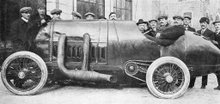
You will notice that I have now included a picture on the right-hand side of the page. This will change from time to time, and where possible, I will of course credit the photographer. Given that the first one was taken in 1908, I am afraid that I have no idea who made the photo! It shows Algernon and Kenelm Lee-Guinness with their land-speed record V-8 Darracq - all 25 odd litres of it! They were brave men... The Darracq has been rebuilt and the story may be found here

I have reposted this because I was experimenting with the link (to open in a new window). This didn't work and caused chaos...

Wednesday, November 22, 2006

Comment or Chat?

You will see on the right of my page, that I have now added a "CBox" - Chat. This gives visitors the opportunity to add any quick thoughts or opinions they might have. I look forward to hearing from you.

To start you off, how about the mouthwatering pic I have attached? Yes it's the engine compartment of arguably the most famous Fulvia of them all: Sandro Munari's "No 14" that won the Monte-Carlo Rally in 1972, helping Lancia to their first World Rally Championship.

I took the picture at the Fulvia 40th nniversary celebrations in Turin in September, 2003. More of this anon.

A Little Gift for Lancisti

Tired of the boring white arrow on your screen? Well, how would you like an animated LANCIA pointer on your computer?

I have one, designed by a friend ( justin@jusdesign.co.uk ) that I will happily send to you if you care to contact me on var1016@gmail.com.

Unfortunately it is not possible to display the pointer here (nor to attach the file) but it incorporates the Lancia shield in blue on a yellow background. - blue and yellow, the classic Montebello colours used on HF badges and stripes! And even better, it rotates...

Tuesday, November 21, 2006

COMMENTS: More "Just Criticism"

Apologies to all who have attempted to comment - unfortunately the function was incorrectly set (by me (blush)).

I have now changed the settings, and all can now comment - but please note that all comments are moderated, so no SMS language or insults please as they will not appear!

Monday, November 20, 2006

A Blogger's Reply to Just Criticism


Shostakovich enthusiasts will know where the title came from...


I have been criticised by some readers for not including enough pictures, so for now, to brighten things up, I have attached another snap of the Fanalone that I mentioned earlier in the blog - the one I prepared for historic rallying. This shot was taken on the Rallye Vins-Macôn in 2003.

My Links

I am gradually adding links that I hope will be of interest. Those who explore them will find that they are not always about Fulvias, but if you read my profile, you will see that I have a number of interests, and sharing interests can be very rewarding.

I must apologise, but despite my plug for Beta Blogger, so far I am unable to make the links open in a new window. Please be patient: as soon as possible I will correct this (i.e. when I find out how to do it!)

Beta Blogger

Blog fans may know about the Beta version of Google's Blogger.

For those like me who cannot believe that anything can work with HTML I strongly recommend Beta Blogger. I have attached a new link that provides some information - it has the rather insulting title "Beta Blogger for Dummies". Ah well, sometimes it's best to own up!

A reminder...

Just to remind you all, I am available to give your Fulvia the care and attention she deserves. I am near Cruseilles (74350) about 30km from Geneva. Contact me on VAR1016@gmail.com

Another tip soon

Saturday, November 18, 2006

Fulvia Thoughts - 3

Today, the subject is the thermostat

The thermostats fitted to Fulvias (and Flavias and 2000s) are in my experience very long-lasting. This of course is a good thing, but of course, does not mean that they do not get “tired” and start to misbehave.

I have had a few experiences but only a few and of course, over 25 years.

First, they sometimes stick – either partly open so that the engine is reluctant to warm up, or shut so that it overheats. These problems can be spotted easily provided one keeps an eye on the most important gauge on the dash, namely the water temperature gauge (well at least before speed cameras and police radars started to appear!).

Not long ago, I came across a slightly strange case. The engine in question had not been run for a few months. All had been fine the last time it had been run, but on firing up, the engine very quickly got hot whilst the cooling fan failed to start. I found that there seemed to be little circulation of water: the radiator was mostly cool. I was inclined to suspect the water pump, since such symptoms are often found with pump trouble.

However I decided to have a look at the thermostat. On removal of the top hose I quickly saw the problem. The little metal strap that locates the central element of the thermostat had snapped, causing the unit to stay firmly closed.

As is often the case with old cars, diagnosis is one thing, rectification quite another.
I had a new thermostat, but the big problem is removing the old one. After countless years screwed into the end of the aluminium water pipe it was as usual, thoroughly corroded. From experience I know that in such cases, penetrating fluid is usually not much use – unless of course one is prepared to wait for weeks. The aluminium water pipes are often corroded too and apt to become weak, and of course a good thread is necessary to take the new thermostat.

The solution was fairly simple. Whilst bearing in mind that the thermostat is quite close to the carburettors, the trick is to heat up the pipe around the thermostat with a blowlamp; a normal gas blowlamp such as is used by plumbers is fine for the job. Use a heat shield, say a piece of aluminium sheet, if you are concerned about the carbs. Afterwards, with a Stillson wrench or a large pair of selfgrips it should be possible to unscrew the thermostat. You will see that the thread looks horrible: full of white powder. Give this a thorough wire-brushing, check for cracks which are quite common, apply “Copaslip” (i.e. copper-loaded grease) and fit the new thermostat – it does not have to be super-tight (just in case).

I shall offer some thoughts about water pumps some time soon.

Sunday, November 12, 2006

Fulvia Thoughts - 2

Hello.

Sorry for the delay, but I've been off line for a few days.

Et aussi, je suis désolé pour mes amis français, mais il est difficile pour moi d'écire en français.

Today, the subject is the oil filter.

You are all familiar with the rather large oil filter fitted to Fulvias I am sure.

Working on later Lancias and indeed, other more modern cars, I began to wonder why the Fulvia had to have such a large filter. I was, I remember, surprised to find that the same item was specified for the Datsun (Nissan) Skyline of the mid-sixties.

Of course, oils were nowhere near as good at that time as they are today. And then I considered that a Lancia Delta Integrale Evolution, with its 2-litre, 16-valve turbocharged engine, producing around 215HP probably made greater calls on its lubricant than did the Fulvia, and if the Integrale was happy with its small filter, then so my Fulvia should be.

Now, the Fulvia’s filter is installed “inverted” and to ensure availability of oil at start-up, a steel tube is installed that passes up the centre of the filter. Modern filters that are mounted this way are fitted with a special valve, which serves the same purpose as the tube.

I decided to take the plunge. I removed the tube by unscrewing the threaded boss to which it is brazed (and onto which the filter screws). I then cut off the tube, cleaned the part carefully and refitted it. I then fitted a Lancia Integrale filter. This was some years ago and I have had no problems.

I appreciate that many will prefer to preserve originality, but for me, the new filter is smaller, easier to remove and lighter. Importantly, it is also easily available. In fact I know that there are numerous modern filters, fitted with the all-important valve, which have the same mounting thread. The thread is a common size; just select a filter that is normally mounted horizontally or inverted like the Fulvia’s ensuring of course that the diameter of the rubber seal is the same as the Fulvia’s. As far as I know all these will have the valve inside, which is quite easily seen. But please check before fitting!

Friday, October 20, 2006

Fulvia thoughts - 1

Greetings to all Fulvia owners and fans.

I have enjoyed 25 years of owning, working on and driving Fulvias, but also talking about them. This post is the first of an occasional series where I propose to talk in brief about details of these cars and share some experiences which I hope that you will find interesting. There will be no logical sequence, just as the ideas occur to me. Of course those with specific questions are welcome to email me on var1016@gmail.com.

Today's topic is timely. With the autumn arriving those who wish to drive their Fulvias as it becomes colder will be thinking about their heaters. Heaters are often a problem on Fulvias and especially on Series 1 cars where the design was perhaps less than perfect...

So S1s first. An S1 is at least 36 years old and as flow through the S1 heater is not vigorous, owing to the design of the heater matrix itself and also the smaller diameter of the hoses etc., the matrix can easily become filled with muck. This is easy to cure.

However, the first thing is to check flow. The heater tap (under the bonnet controlled by a steel cable) is sometimes the cause of problems. Inside, there is a rubber diaphragm which, with age can swell and obstruct flow. Disconnect the hose between the tap and matrix and check flow through the tap. If there is little flow, then either it is turned off (!) or the rubber is unserviceable. New rubbers can be purchased from the usual suppliers such as Omicron or perhaps Cavallitto. Before dismantling the tap, note carefully the position of the parts, otherwise it is a straightforward job.

Turning to the matrix, disconnect the hoses from from a) the heater tap and b) from the radiator drain tap (subframe RH side). First apply a flow of water from a hose pipe to the drain tap end of the circuit (keep the heater tap hose away from the engine!). This is called "back flushing". With luck there should be at least some water flowing - if not, it means removal and replacement of the matrix. So long as there is flow you have a chance. From a builder's merchant, buy some drain cleaner. Mix a mild to moderate strength solution of this and through a funnel, apply it to the circuit. You will find the heater tap end easier. when the mixture starts to run from the other (drain tap) end raise the drain tap hose to stop the flow, top up again at the funnel and leave the whole thing over night. Back flush the next day with care, again keeping the hoses clear of the engine. An amazing quantity of horrid brown sludge should appear. This is a good thing. When the water is running clear, you can reassemble and refill the system with your normal coolant mixture.

At Evolution Engineering, we tackled several of these and the results astounded the owners!

For S2 coupés, the procedure is similar but not the same, because the heater tap is mounted next to the unit, next to the LH footwell. Here it is best to disconnect the upper hose from the end of the aluminium water-pipe on the inlet manifold and use another piece of hose to direct the test water away from the engine. The heater taps are not repairable. Normally they do not become obstructed but spring leaks helping the normal rust problem on the front floor... If you have a leak here then you must replace the heater tap. Not much help I know, but I believe that some Betas were fitted with the same tap, but Fulvia ones are sometimes available - indeed may be reaily available from some of the well-known suppliers.

S2 berlines have a heater tap similar to that on the S1 coupés, but mounted on the heater box under the bonnet by the scuttle, so the comments about the S1 above are appropriate here.

I wish you all a warm driving experience in the winter.

Until the next time, best wishes.

Wednesday, October 11, 2006

Et maintenant en Français...

La Lancia Fulvia
Un spécialiste de cette voiture en France


Je me présente : Paul Leclercq, j’ai 25 ans d’expérience avec l’auto mythique qu’est la Lancia Fulvia (et en plus nombreuses autres autos classiques), et je peux mettre ces connaissances au service des passionés de la Fulvia: conseils, service etc. Egalement, je peux vous aider avec la mécanique 4-cylindres “boxer” des modèles Flavia et 2000.

Je suis en Haute-Savoie (74), près de Cruseilles, quelques 30 km de Genève.

Vous pouvez lire mes conseils et mes commentaires pratiques sur le site de Huib Geurink www.viva-lancia.com qui est la référence sur la Toile pour tout ce qui touche aux Lancias classiques. J’ai été directeur de l’entreprise spécialiste Lancia “Evolution Engineering” à Londres pendant plusieurs années avant de m’installer en France.

La photo ci-dessus montre une superbe Fulvia 1,6 HF “Fanalone” dont le moteur et la suspension avant ont été préparés par mes soins pour courrir dans les rallyes historiques. Cette auto a remporté trois championnats féminins VHC à sa propriétaire et ses co-pilotes. Aujourd’hui, l’auto a accompli 20 rallyes sans recours à la moindre intervention importante. Pendant ces quatre années, l’auto n’a connu qu’un seul abandon pour faute de câble d’accelerateur cassé.

Mon enthousiasme pour ces autos attachantes m’ont aussi conduit à développer des améliorations. Ma propre auto, sur une base de Fulvia Coupé, est bien connue du cercle Lancia en Grande-Bretagne, avec son injection mécanique Lucas et l’adaptation d’étriers de Coupé Fiat 20V modernes et de disques ventilés Willwood en lieu du système de freinage d’origine. Ci-jointe une photo de ce bolide en pleine action à Goodwood. Vous trouverez plus d’informations sur cette auto dans le registre Fulvia du site viva-lancia.com.


Quant aux autres Marques, voici une sélection de quelques photos de mes travaux, comme ce moteur Mercedes-Benz 220S injection de 1960 que j’ai refait complètement, ou ce moteur Delahaye de 1950 aussi refait, ou bien la révision d’une batterie de carburateurs Weber de Lamborghini Miura.


Pour tous renseignements où demandes, n’hésitez pas à me contacter à l’adresse VAR1016@gmail.com

J’attends de vos nouvelles !

Sod the Law!

SMOKING IS NOT ONLY PERMITTED ON THIS BLOG - IT IS ACTIVELY ENCOURAGED

New Internet Speed test

Music and Radio Blog Club

Radio Blog Club, a good friend for a while appears to be in some legislative difficulty...

However, in tribute to its brave effort, I shall leave the existing track on this page (which amazingly still works)

Sadly my Playlist no longer works (hence its removal) thanks to the absurd "Hadopi" legislation in France. Apologies to all.