Adsense

A bit of music from the lamented Radio Blog Club

Le Français

Toujours, je suis désolé pour mes amis( et amies) français(es), mais il est difficile pour moi d'écire en français. Peut-être un jour...
S.V.P. regardez ce LIEN
Showing posts with label Napier. Show all posts

Sunday, December 23, 2007

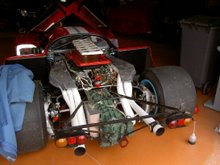
Isn't it Lovely?


Source: here

Do it yourself?

I don't think so. Despite having this wonderful picture to hand, I am not yet able to offer servicing and overhaul of Napier Sabre engines!

A bientôt

Friday, December 21, 2007

Quick Note - Sabre again!

In this thread on a forum I found, some kind soul has scanned a set of pages from Setwright's book "The Power to Fly" which gives a bit more of the story.

Especially interesting on fuels.

A bientôt

L.J.K. Setwright & the "Sabre" engine


Now thoroughly gripped by the subject, I have found a super article about the Napier Sabre Engine.

The original and iconoclastic L.J.K. Setwright was obviously as smitten as I am! The article is replete with his interesting and highly technical observations - in particular note his comments about combustion chamber shapes. The horsepower figures, apparently from a reliable source more than confirm what I wrote the other day, but Setwright is, I am sure, incorrect in his observations about thinwall bearings, which he credits to Napier. These were invented by the Clevite Corporation in the U.S.A. and it was Tony Vandervell who, by staying on the reception sofa at Clevite's offices for two days in or around 1932, finally got them to give him the European licence to make the bearings in his works at Acton, west London.

The article also "lifts the lid" on the acrimony and bitter competition between the aero-engine makers in England, whilst the country was fighting for its life. I have read the biography of Roy Fedden, boss and designer at Bristol engines and the author, whose name I regret escapes me, endeavoured to fight Bristol's corner, rather as Setwright has tried to do for Napier.

A bientôt

More "Tempestuous" Stuff

The Tempest has taken me over.

As I said, it is one of my favourite aircraft. My excuse for including the clip (from You Tube) is the glorious sound of the 24-cylinder, 2000+ HP, sleeve-valved, supercharged, 150-octane-guzzling Napier Sabre engine.


This film is obviously an Air Ministry training feature intended to obviate "friendly fire", but there's some good flying, great sounds and the whole thing, given the epoch, was very well done I think. Imagine the work - without computer imaging!

A bientôt

Thursday, December 20, 2007

Knock, knock, knock + an Apology

Source: here

I must have been asleep!

In my recent article about knock, I featured a picture of a Hawker Tempest, one of my favourite aeroplanes. Unfortunately, the version shown obviously has a radial engine, and was therefore, one of the Bristol-engined variants - my extracts at the end of the article related to the "other" engine.

The picture above shows a "proper" Tempest, fitted with the staggeringly complex Napier Sabre engine - the one that used the 150-octane fuel. For those who do not know about this, it was technically fascinating, but really a nightmare for anyone who had to do anything with it. It was a sleeve-valved, 24-cylinder, supercharged job, with the cylinders arranged in "H" formation - i.e. two flat-12s arranged one above the other. It was very powerful - I recall reading somewhere that Napier achieved 100 BHP per litre with a prototype, a staggering achievement in an aero-engine. The site (devoted to the Tempest) that provided the picture is here.

However, complexity has its price of course. It was said that during the Second World War, a horsepower from Napier cost the British taxpayer £3. A horsepower from Bristol cost £2, whilst a horsepower from Rolls-Royce cost just £1!

Napier (formerly a car manufacturer) was acquired by the English Electric Company in 1943; the final aircraft effort was even more outrageous: this was a cruciform ("X") engine; both supercharged and turbocharged, it produced over 4000hp, but jets had arrived so that, as they say, was that. Napier did have success later however with the fascinating "Deltic" engine, used in railway locomotives and also I think, in ships. A diesel, this was triangular in section as its name suggests. There were three crankshafts (one at each corner) and six (opposed) pistons per row. Think about it!

Meanwhile, following William's comment on the last article, I am looking into ignition modifications. If my searches are succesful I shall be back on the thorny "knock" problem.

A bientôt.

Sod the Law!

SMOKING IS NOT ONLY PERMITTED ON THIS BLOG - IT IS ACTIVELY ENCOURAGED

New Internet Speed test

Music and Radio Blog Club

Radio Blog Club, a good friend for a while appears to be in some legislative difficulty...

However, in tribute to its brave effort, I shall leave the existing track on this page (which amazingly still works)

Sadly my Playlist no longer works (hence its removal) thanks to the absurd "Hadopi" legislation in France. Apologies to all.