I must now try to explain at least in broad terms, how the Kugelfischer system functions, since this has a bearing on subsequent problems and work. Kugelfischer mechanical injection was used well into the 1980s on the Porsche 956 cars that ran at Le Mans, on the BMW M1 Le Mans cars and on F3 cars up to the end of the 1980s, long after the appearance of electronic systems.

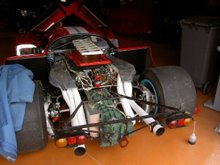
In this picture may be seen the throttle bodies and Kugelfischer injection pump
together with the throttle linkage (see text)
The system is quite elaborate and superior in many ways to the Lucas type on my own car. In essence it functions rather in the same way as a diesel pump with four plungers, one for each cylinder pumping fuel at high pressure to the injectors. The high pressure ensures excellent atomisation – a boon on a Fulvia with two of its inlet ports being so long. Fuel control is determined first by the control lever which is connected to the throttle linkage. Inside the unit this basic setting or more precisely, its curve, is controlled by a three-dimensional cam (nicknamed “the potato”). The “potato” is also free to rotate and its position is determined by engine speed this being achieved by an aluminium disc influenced by a magnet acting against a long clock spring. It is difficult to imagine how the “potatoes” were manufactured on a production basis. They are made from hardened steel and are very complex in shape. One can imagine that many, perhaps hundreds of hours were spent in finalising the shape of the three-dimensional cam.
Naturally we had no intention of making our own “potato”…
With the engine assembled, we realised that installing it in the car would also require a great deal of special work. So we decided to have a break and run the engine literally on the bench! This was quite easy to do: a fuel supply and radiator etc. are easily rigged up. We had many happy hours running the unit and probably poisoning ourselves with exhaust gases at the same time.

The testing was worth it however. First we found that the engine, despite our worries ran remarkably smoothly, but we also found that it appeared to run rather lean. We tried adjusting the clock spring to dampen the movement of the cam but this seemed not to help. Finally I designed a little lock plate which fixed the cam in one position (the richest) with a second plate available which would be slightly leaner. Effectively it was now running in Lucas mode with a simple cam – i.e. one curve on the “potato”. It was now time to confront the problems of installing the engine into the car so we could try some road testing.
Installation
The first problem we encountered concerned the cooling system. Whilst a lightweight aluminium cross-flow radiator (ex-Metro turbo) was installed, there was no room at all for even a thin cooling fan since the injection pump and pulleys took up much of the space in that area. The problem was solved in a rather ingenious albeit eccentric way. A radiator from a 500cc motor-cycle was purchased second-hand, complete with its electric fan. This was mounted at an angle behind the LH headlamps. Justin fabricated some elegant aluminium ducting for this, with a louvred section being let into the inner wheel arch to provide an exit into a low pressure area for the hot air.
On first trying the engine in the car, we found circulation problems. Various piping arrangements were tried until finally we arranged the pick up to the water pump from the link pipe between the two radiators (notionally at the “bottom”). The little fan is just enough to keep the engine cool, but I wouldn’t bank on it in tropical conditions.

View of engine compartment. The aluminium ducting may be clearly seen,
with the breather bottle mounted upon it
The rest of the installation was not difficult; just a question of mounting the Uno Turbo fuel pump at the rear and the Lucas regulator and filter in the engine compartment. A fuel return was necessary of course for the "spill" from the regulator. An exhaust system was made up to mate with the manifold, so all was ready.

Another view showing the oil cooler installation
Note the opening in the top of the wing to provide an air supply
(there is normally a cold air box and filter mounted)
Initial Results
On trying the car we believed that we had what was a major success; the engine was powerful and had a surprising amount of torque – this we certainly had not expected given the rather extreme valve timing. And the engine was also very smooth as the bench tests had suggested; this again was really quite a surprise.
The one flaw was a very jerky take-off. We later found that there was an error in the bell crank ratios in the throttle linkage which incidentally may well have caused the apparent leanness in the early tests.
There was a track day at Brooklands at this time and Justin entered and had great fun. On the way back on the M3, whilst I was cruising happily in my Dedra at 115mph, Justin simply sailed past me in the 1486 with a big grin on his face.
Just after this Justin invited Barry Waterhouse to try the car. He was impressed and reckoned that it had “at least 140bhp”.
Nemesis
With various minor tweaks, Justin was really looking forward to the Lancia Motor Club track day at Goodwood. My own Fulvia being in pieces at the time, I followed him down in my Dedra. Sadly, near Godalming, he stopped, with the temperature gauge off the clock and clouds of steam. We hoped that it was perhaps just the head gasket but sadly it wasn’t: the sump oil had turned to yoghurt…
Back at our workshop we eventually found that one of the cylinder bores had cracked; obviously the overbore had been too much.
Justin had the damaged bore lined, but this failed too – there was not enough material to support the very thin liner.
Some time later, Justin had another block bored. This time, he selected a slightly wider angle – about 12° I recall. Unfortunately, this block which had been bored with great care by a specialist who understood what was being attempted, failed very quickly indeed.
Subsequently, Justin had the bottom sawn off this wrecked block and straight away we could see that the cylinder bores were not concentric with the walls. Obviously when cast as a 1300 block, there is plenty of margin to allow for core shift, but of course we were rather “pushing the envelope”. It was very frustrating, as some of the cylinders were fine; it was simply that the bore was off-centre in one place. There is no easy way of telling where the limits of the cast cylinders are.

The second block, with the bottom sawn off. Note the extreme thinness
Of the cylinder wall on No 4 (top of picture)

The section that was cut off: the red circle shows the problem on No 4
Note also that the other cylinders are much better in this regard
At present the car has a 1300 engine installed, still running the Kugelfischer injection and with the nice exhaust manifold. It goes quite nicely, but nothing like the 1486 which really was a flyer. I am also certain that there was more to come from that engine if only it had stayed together.
I believe that if 81mm pistons were made, the project would have a reasonable chance. Of course this would be a “1437” and not a 1486.
One last thought: some of may know that the Squadra Corse under Tonti experimented around 1967/8 with an 80mm bore version of the 1300 engine giving 1401cc. This was known as Variante 1014. I recall that they had head gasket problems with this engine. We had many problems as I have outlined above, but never a problem with the head gasket. Funny that…
 Click on the image for full size